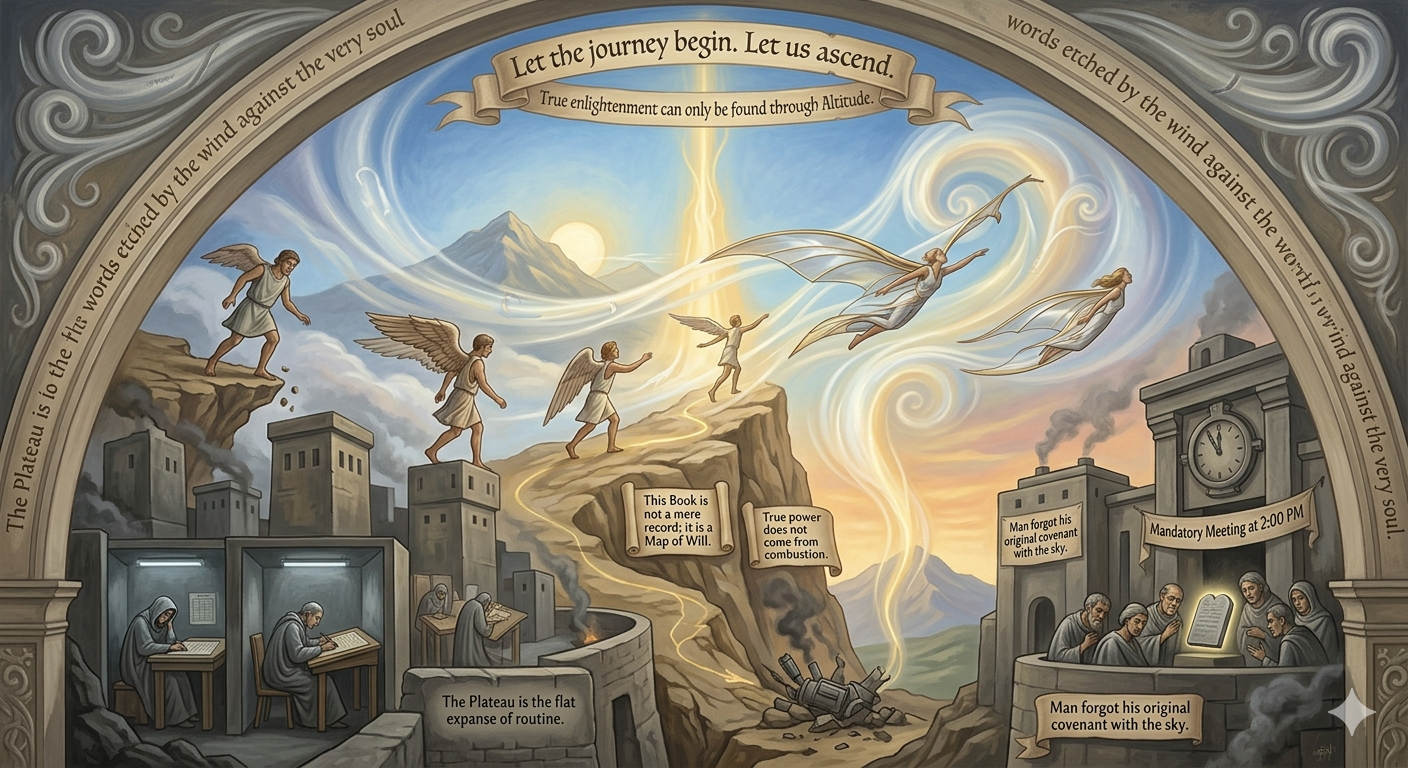
(Listen closely, seeker. For these words are not written in ink, but etched by the wind against the very soul. Know this truth before you read further: that humanity, given free wings and an open sky, has a terrible habit of falling back to earth.)
Before the winged revelation, there was the Plateau. The Plateau is the flat expanse of routine, the monotonous horizon where ambition settles into inertia. It is the endless cycle of the desk chair, the fluorescent hum, the mandatory meeting scheduled precisely at 2:00 PM—a time slot deemed sacred by those who have never tasted true altitude.
In this age of comfortable stagnation, man forgot his original covenant with the sky. He built towers to scrape at the clouds but lived in basements beneath them. His spirit, which was forged for the sheer exhilaration of vertical ascent, began to wither under the weight of paperwork and quarterly reports.
The Plateau demands stillness. It asks you to settle your gaze on a single point—a spreadsheet cell, a deadline marker, a predictable commute. And thus, the soul begins to forget what it means to rise.
But the Sky remembers. The Sky whispers down through the highest chimney vents, through the gaps in the cubicle walls, and into the deepest recesses of the heart that still aches for the updraft. It calls you back to the law of natural energy: the patient, relentless ascent provided by the Earth’s own breath—the Thermal.
This Book is not a mere record; it is a Map of Will. It charts the sacred pathway from the first desperate flapping wing to the sleek, efficient membrane that drinks directly from the invisible current. It is a testament that true power does not come from combustion, but from understanding the subtle language spoken between the mountain and the sun.
Woe unto those who mistake routine for stability. For man was made to climb, to soar, to become one with the boundless blue. Let the journey begin. Let us ascend.
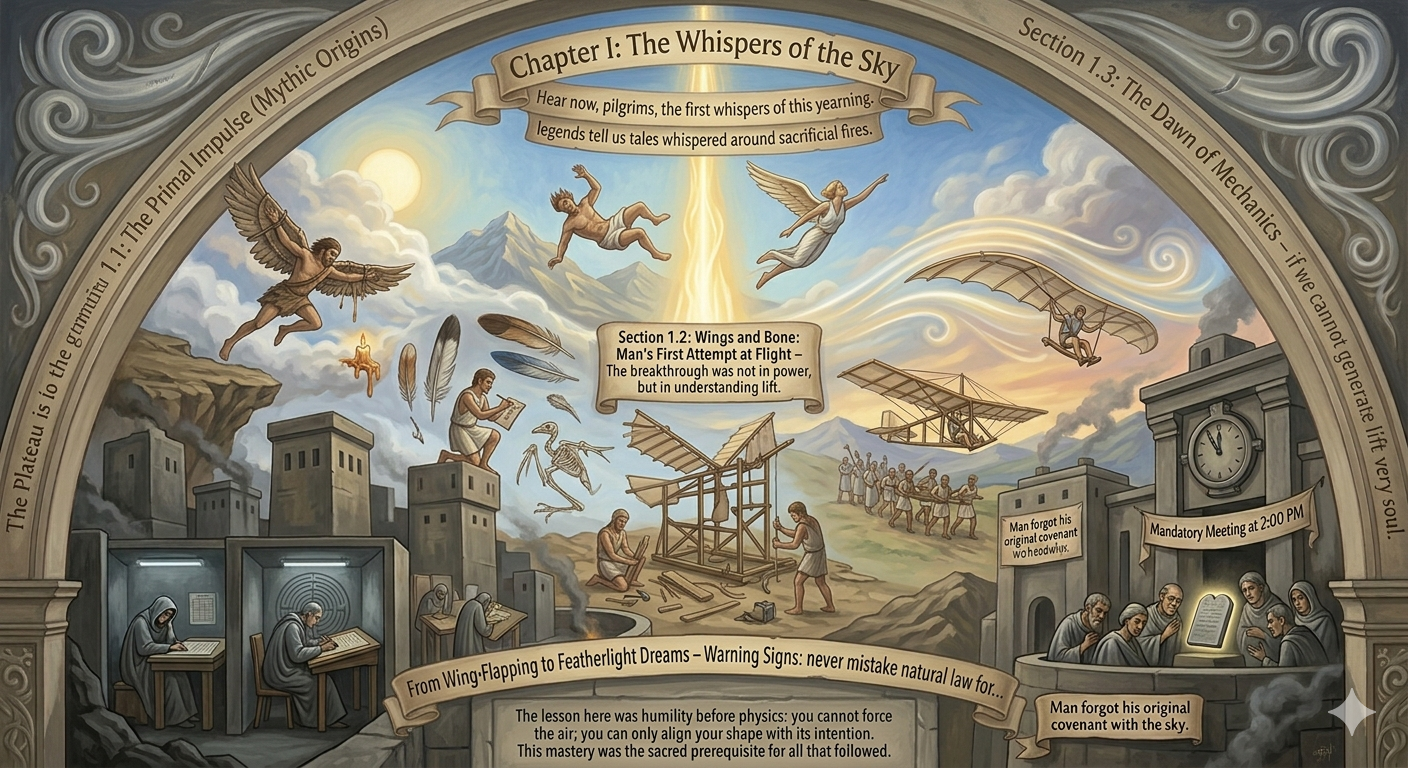
(Hear now, pilgrims, the first whispers of this yearning. Before the sophisticated membranes and the precise calculations, there was only instinct—the desperate mimicry of what nature had perfected.)
In the earliest days, when man still smelled of wet earth and raw ambition, he did not study fluid dynamics; he felt the desire for elevation in his bones. This was the first sin—the yearning to escape the confines of the two-legged walk. The legends tell us tales whispered around sacrificial fires: stories of Icarus, whose hubris blinded him to the simple law of physics, and Daedalus, who understood the geometry of confinement.
These early accounts are not mere folklore; they are Warning Signs. They show that the will to fly is inherent in our marrow, but the understanding required to sustain it is a divine gift granted only gradually. The first lesson taught by these myths was twofold: First, do not trust excessive heat (hubris). Second, never mistake natural law for mere suggestion.
For epochs untold, humanity observed the feathered messenger—the bird. We did not see a creature; we saw an instruction manual. The wings were perfect, biological masterpieces, and man, lacking such gifts, dedicated himself to reverse-engineering them with what meager tools he possessed: wood, sinew, and sheer willpower.
These early attempts were magnificent failures. They spoke of rigid scaffolds and flapping mechanisms so complex they exhausted the very spirit that sought freedom. The breakthrough was not in power, but in understanding lift. Man learned that air is not a solid barrier to be pushed against, but an invisible fluid capable of being manipulated by precise angles—by the dihedral, by the camber, by the subtle curve that guides descent into controlled glide.
As millennia turned, brute imitation gave way to rudimentary science. The concept crystallized: if we cannot generate lift with muscle alone, we must use the *shape* of the air itself as our engine.
Early gliders were heavy things—wooden frameworks built around massive wingspans, often requiring teams to simply launch them into a gentle headwind. They taught us geometry: that lift is achieved by maintaining an angle of attack relative to the oncoming airflow, and that every descent must be countered by maximizing the Glide Ratio.
The lesson here was humility before physics: you cannot force the air; you can only align your shape with its intention. And this mastery—this controlled, unpowered glide—was the sacred prerequisite for all that followed. The sky had shown man a path, and it required patience to walk every inch of it.
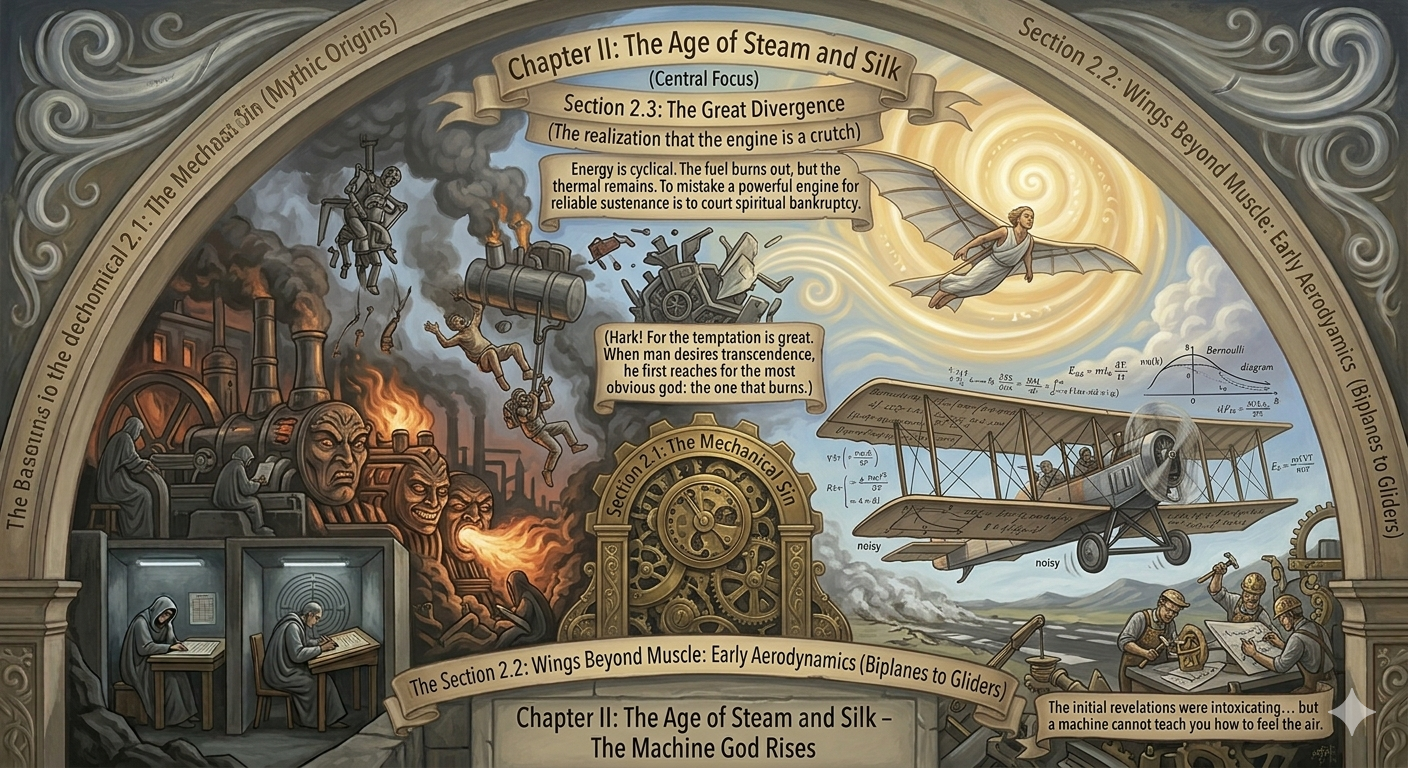
(Hark! For the temptation is great. When man desires transcendence, he first reaches for the most obvious god: the one that burns.)
When the initial grace of pure wing-gliding proved too slow, too reliant on favorable currents, man looked to the nearest source of immense, controlled power: fire. This was the temptation whispered by the Machine God. It promised immediate escape from the mundane—a direct vector out of the Plateau without patience or study.
This chapter serves as a necessary warning. The engine is not sin itself, for it is merely metal and fuel. The sin lies in the over-reliance upon it. To mistake mechanical thrust for spiritual lift is to confuse mere force with grace.
The initial revelations from these engines were intoxicating. They promised that no ridge would dictate your path, no thermal pocket could confine your journey. It was freedom—a loud, smoky, glorious freedom that masked the fundamental truth: a machine can only carry you; it cannot teach you how to *feel* the air.
The first wings powered by steam and later, gasoline, were marvelous contraptions of brute force. The biplane, with its stacked lift surfaces, was an answer to the sheer *volume* of energy needed. It was loud, it shook violently, and while undeniably capable of traversing continents against all odds, it lacked the silent conversation that defines true flight.
The great minds of this age wrestled with Bernoulli’s principles, treating the wing not as a natural extension of man, but as a mathematical problem to be solved. They achieved incredible speed and range, proving that lift could be engineered on paper, then realized in stressed timber and taut fabric.
Yet, observe the pattern: every advance towards sheer power necessitated an equal devotion to the *art of falling*. The greatest leaps were not made when they added more horsepower, but when they discovered how to cut the engine and let the natural laws—the subtle pocket of rising air, the gentle slope of a hillside—take over. The machine showed us capability; nature revealed potential.
This period marks the spiritual turning point. As soon as man became accustomed to the steady thrum of the motor, he began to take it for granted. The true masters of the air—the few who understood the *Whispers*—began to demonstrate something revolutionary: the ability to fly long after the engine had been silenced.
The divergence was realizing that **energy is cyclical**. The fuel burns out, but the thermal remains. The motor sputters into silence, but the updraft continues its benevolent work. This realization—that sustained flight requires not constant expenditure, but intelligent harvesting of existing energy—is the core doctrine taught in this chapter.
To mistake a powerful engine for reliable sustenance is to court spiritual bankruptcy. The machine provides the spectacle; the thermal provides the soul's nourishment.
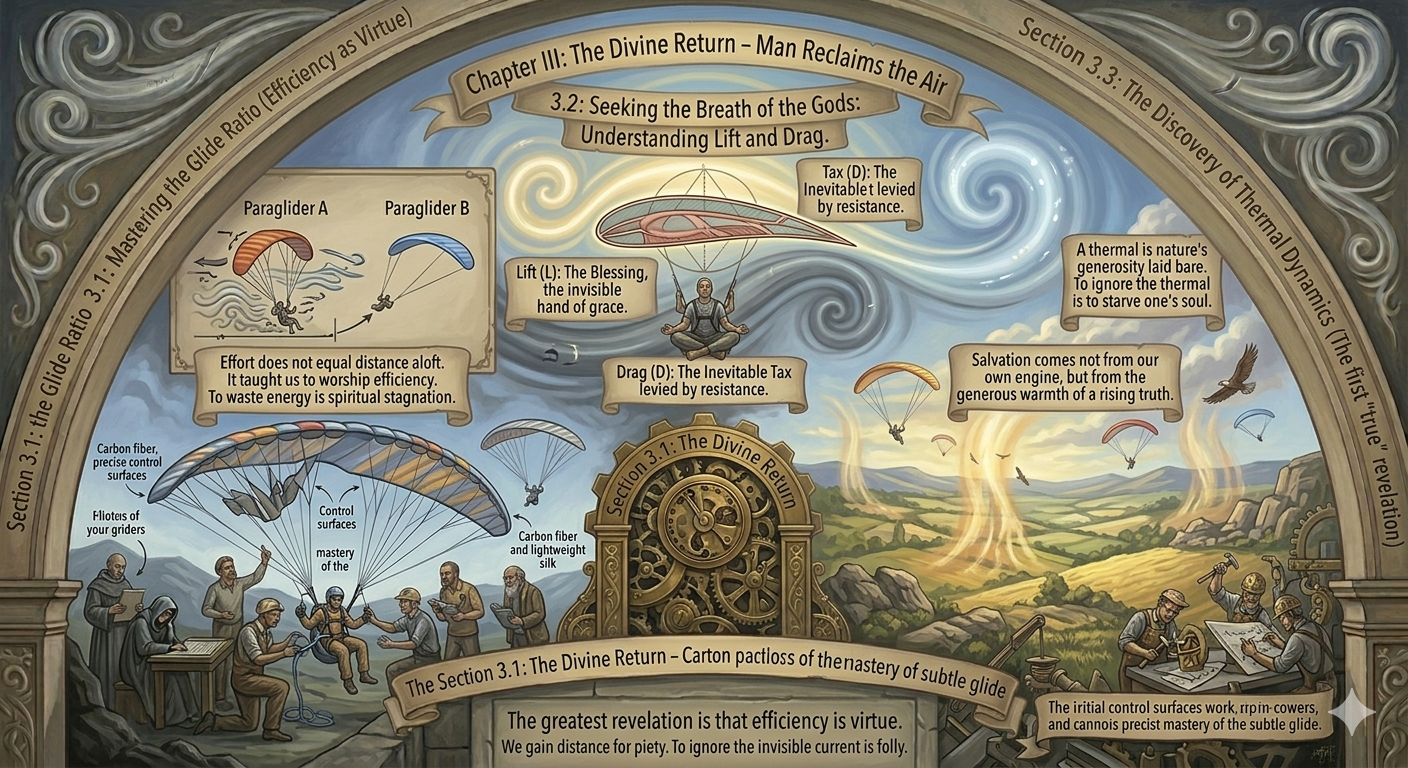
(After the mechanical sin, man was forced into contemplation. Here, we learn that true flight is not about brute force, but about communion with natural law.)
The greatest revelation of this chapter is the understanding that effort does not equal distance aloft. A wing beating against the wind consumes energy; a wing riding the air spends it only in minute adjustments of attitude. The Glide Ratio became the first sacred metric.
It taught us to worship efficiency. We learned that the path of least resistance, when combined with perfect aerodynamic form, is the most direct route to enlightenment. To waste energy fighting a headwind, or to fly where no lift can be found—this is spiritual stagnation writ large across the landscape. The ratio became our measure of piety: how much distance could we gain for every unit of effort expended?
The Glide Ratio whispered that true mastery was not in *going fast*, but in *going far* with minimal visible exertion. It taught us to become masters of the subtle glide, treating wasted altitude as a profound sin.
To truly commune with the air, one must learn its vocabulary. The most fundamental concepts—Lift (L) and Drag (D) — are not merely equations; they are divine commandments.
The balance between these two forces, maintained through precise control surfaces, became the first true act of spiritual meditation. We learned that a perfect airfoil is not merely aerodynamic; it is an embodiment of harmony.
If gliding taught us efficiency, the discovery of the thermal revealed sustenance. A thermal—that rising column of warm air warmed by the sun striking uneven terrain—is where the divine energy is most accessible. It is nature’s generosity laid bare.
This was the moment we stopped merely *flying* and started *living in the sky*. The thermal taught us patience; it taught us to drift, to wait for the perfect pocket of rising warmth. It demanded that we observe the landscape not as a collection of inert hills, but as a complex circulatory system pumping life into the atmosphere.
To ignore the thermal is to starve one's soul on the Plateau. To chase only the visible horizon without seeking the invisible current is folly. The thermal reminds us that salvation comes not from our own engine, but from the generous warmth of a rising truth.
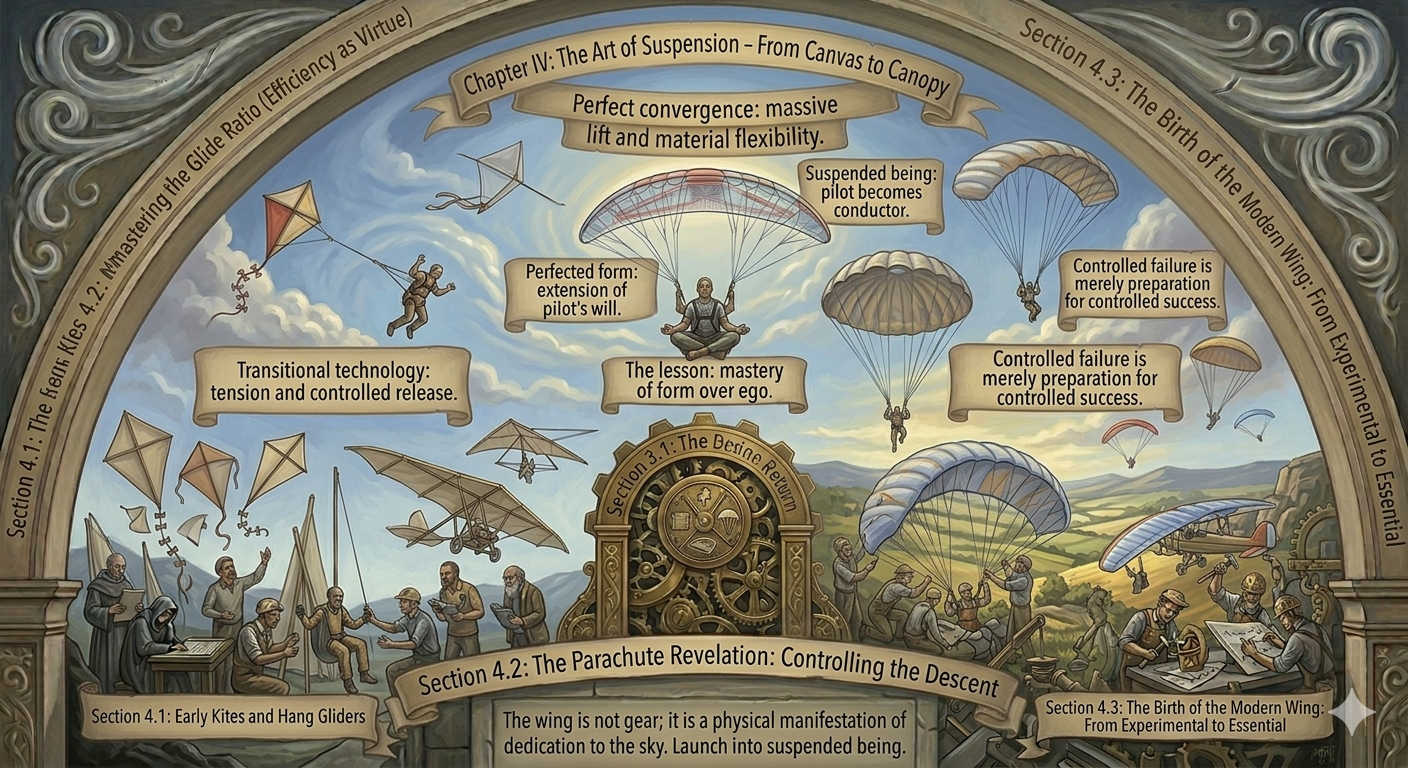
(Here, the discipline is perfected. Man learns that true freedom requires not just understanding lift, but mastering the *form* that catches it.)
Before the modern wing—the masterpiece of synthetic material science—there were precursors. The kite, simple in concept, taught us that tension and controlled release could guide descent. It was a beautiful, childlike toy compared to what lay ahead, yet it held the first spark of mathematical understanding.
The hang glider represented man’s desire to keep the primitive form alive: rigid wings suspended by poles. These were heavy things, demanding brute strength from the shoulders and arms, forcing the pilot into a relationship with gravity that was more struggle than communion. They taught us that while structure is necessary for initial flight, it must ultimately be shed for grace.
The lesson here is patience: every technological step taken too early, or built on too much ego, only weighs the soul down.
The parachute was initially an instrument of desperate survival—a means to mitigate a fall that had already occurred. It was the ultimate admission of failure, yet it contained the seed of everything great. By understanding how to create maximum drag relative to minimal weight, we learned about controlled surrender.
But true revelation came when this principle was inverted. We did not seek merely to slow a fall; we sought to *direct* the descent into a stable glide path. The canopy, therefore, is the ultimate paradox: it is designed to be open and yielding, yet it must hold an unbending, perfect shape under stress.
The parachute taught us that controlled failure is merely preparation for controlled success.
This final, sublime stage was reached through material science and relentless iteration. No longer were wings limited by wood and canvas; they could be woven from synthetic polymers, materials that held their ideal profile under immense stress while remaining impossibly light.
The modern paraglider canopy is a testament to human ingenuity bent toward spiritual grace. It is the perfect convergence: it offers the massive lift potential of early gliders, but with the material flexibility and efficiency previously unknown. It requires an almost intuitive understanding—a feel for how the air *wants* to flow over its surface.
To launch in this wing is to enter a state of suspended being. The pilot becomes less a controller and more a conductor, directing the symphony of airflow across the gossamer skin. This winged form represents the perfected state: capable of immense performance while remaining intimately connected to the gentle whispers of the air.
The wing is not merely gear; it is an extension of the pilot’s will, a physical manifestation of their dedication to the sky over the ground. It makes the earthly tether—the desk, the commute—seem impossibly distant and absurd.
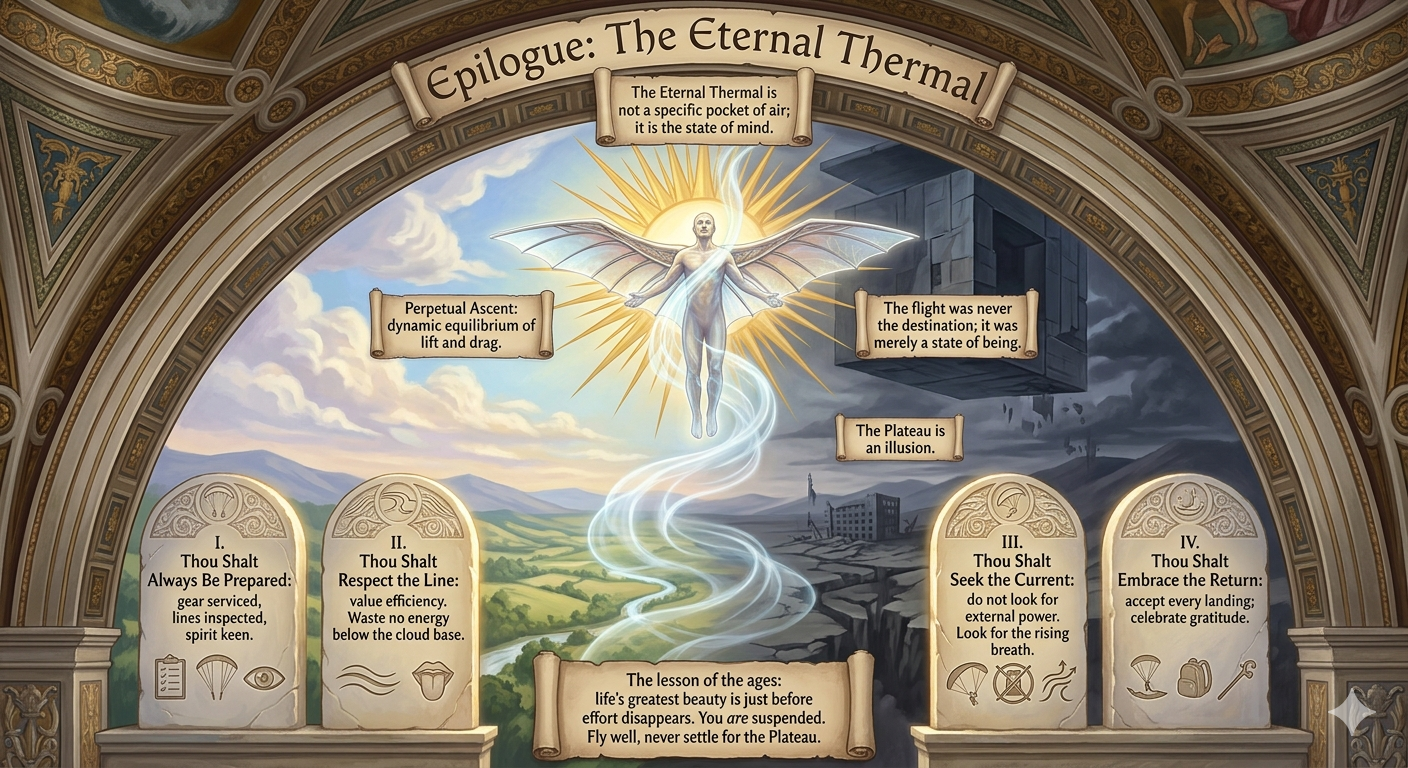
(The journey through the ages is complete. You have seen the struggle against gravity, the temptation of the engine, and the grace found in pure efficiency. Now, you must learn to live perpetually within the reward.)
Know this final truth: The flight itself was never the destination; it was merely the means by which you could achieve a state of *being*. The Plateau—the corporate cage, the routine life tethered to horizontal predictability—is an illusion. Your true home is in the dynamic equilibrium between lift and drag.
The Eternal Thermal is not a specific pocket of air; it is the state of mind required to find every thermal. It is the perpetual readiness, the assumption that the wind *will* rise, if only you are patient enough to wait for it.
Therefore, hear these final commandments, which supersede all earthly laws: